
Teacher – Miss Younge
TA- Mrs Campbell
Summer Term 2026:
Summer Term 2026: Wow! And yet again, It’s been another crazy busy half term in Reception! We can’t believe it’s June already. 
Communication Language and Literacy
In literacy we are definitely starting to become authors and are now learning to write sentences. We have drawn a character and a setting and orally retold our stories. This was fun as we were able to share our experiences with the rest of the class and read our stories out loud. Miss Edwards also helped to bring our characters to life by describing them on AI.
We are still practising phonics daily in our phonics lessons and reading. Daily reading is really important and most of the class are where they should be, learning phase 4.
Maths
In maths we have started to look at what numbers make 10 – addition and subtraction and most of us can count back from 20.
Understanding the World
In history we have researched about toys in the past and found out about the toys our parents and grandparents played with. We even have a Victorian rocking horse in the classroom. We then explored and compared fiction and non-fiction books. In science we have been scientists ourselves and started planting plants in the school garden. This follows on from our learning in Spring term when we learnt about what plants need.

RE
In our RE lessons and worship we have been learning about the values of hope and love. We also talked about how different religions celebrate special times and talked about how Muslims celebrate Eid and Christians celebrate Christmas. We also learnt about how Christians believe God created the world in seven days.
Expressive Art and Design
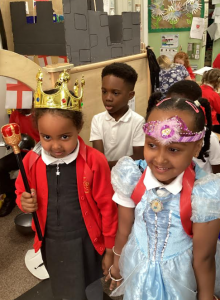
In Design and Technology, we enjoyed designing a crown made out of felt and we collaged some felt pieces on to make a pattern. We then sewn our hats together with a needle and thread.
Physical development
In PE lessons we have been focussing on racket sports and using our good eye-hand coordination. We are also going to take part in sports day and will enjoy the opportunity to take part in an obstacle course, as well an egg and spoon race.
| TOPIC NAMES |
Understanding the World |
EAD (Expressive Arts and Design |

PSED |
RE |
Physical Development |
Literacy (Reading and Writing) |
Maths |
| Reception
AUTUMN
ICT ARTICLE 17 |
AUT 1:
Traditional Tales from Around the World (ART 29/30)
AUT 2: When I grow Up……. (ART 5,6,7,8,9,10, 24,27, 28,29)
|
Painting- Aut1
Drawing-Aut2
Music Express- Amazing African Animals and Busy City (beat and tempo) Stories and sounds (structure)
Nativity songs and performance
Role play- home corner, African roundhouse, police/fire station, post office.
Additional- SEE RECEPTION CURRICULUM DOC.
|
Think Equal
AUT 1: Marvellous Me same and different Marvellous Me These Feelings: understanding feelings These Feelings The Weather Inside Me: understanding that feelings come and go See Learning A: Exploring Kindness See Learning A: Group Agreements
AUT 2: Ted the Tiger Tamer: linking emotions to feelings in the body The Secret Adventures of Anonymouse: acts of kindness Curly the Chameleon: using mood meter to understand emotions See Learning B: Practising Kindness See Learning B: Kindness as inner quality See Learning B: Recognising kindness and exploring connections Ahmed’s journey: connecting body and emotions Faisal’s not himself: recognising boys and girls should express their emotions
Additional- SEE NURSERY CURRICULUM DOC. |
BELIEVING: Which stories are special and why?
Diwali
Remembrance Day
Christmas (Births and birthdays, The Nativity)
Hannukah
Values- Thankfulness, Respect and Love |
Gross Motor Skills
▪ Revise and refine the fundamental movement skills they have already acquired: – rolling – crawling – walking – jumping – running – hopping – skipping – climbing à Engage in and develop confidence in actions ▪ Begin to develop overall body-strength, balance, co-ordination and agility àUse above actions, within obstacle courses … balance, obstacle, spatial, prepositions à Set own physical challenge … challenge, goal ▪ Begin to use their core muscle strength to achieve a good posture when sitting at a table or sitting on the floor … straight, upright, flat ▪ Begin to combine different movements with ease and fluency àSee above obstacle course àChange movements / directions quickly ▪ Begin to confidently and safely use a range of large and small apparatus indoors and outside, alone and in a group àUnderstand rules and reasons ▪ Further develop and refine a range of ball skills including: throwing, catching, kicking àUse different sizes / types of balls – in pairs ▪ Further develop the skills they need to manage the school day successfully: □ lining up and queuing □ mealtimes □ personal hygiene Fine Motor Skills ▪ Use a comfortable grip with good control when holding pens and pencils à Consolidate tripod grip ▪ Continue to develop small motor skills so that they can use a range of tools competently, safely and confidently. Suggested tools: pencils for drawing and writing, paintbrushes, scissors, knives, forks and spoons
|
Reading: Comprehension / Word Reading
▪ Begin to retell simple stories and narratives using their own words and some recently introduced vocabulary. àRecall key events … event àTalk about main characters… character, beginning, middle, end ▪ Begin to re-read books to build up their confidence in word reading, their fluency and their understanding and enjoyment ▪ Understand the five key concepts about print, with a focus on àLeft to right à1-1 correspondence … word, letter, first / last ▪ Continue to develop P1 phonological awareness, focusing on àRhythm & rhyme; alliteration (initial sounds); oral blending and segmenting … blending, segmenting ▪ Read individual letters by saying the sounds for them àSecure P2 phonics … phoneme, grapheme, alphabet ▪ Blend sounds into words, so that they can read short words made up of known GPCs àP2 □ VC words □ CVC words ▪ Begin to read a few common exception words matched to the school’s phonic programme I, go, to, the, no, into … tricky words ▪ Begin to read simple phrases / sentences àApply P2 GPC ▪ Read pink B guided reading books aligned to phonic knowledge Writing ▪ Write name correctly àUse correct letter formation ▪ Use some of their print and letter knowledge in their early writing ▪ Begin to form lower-case letters correctly ▪ Begin to spell words by identifying the sounds and then writing the sound with letter/s, using known GPCs … spell àUse □ initial sounds □ VC □ CVC words àWrite labels ▪ Begin to write lists & captions, focusing on …label, caption, space àOral rehearsal / vocabulary àBegin to reread what they have written |
Match and sort
Compare amounts Comparing mass, size and capacity Pattern- AB Representing, comparing and compositions of 1,2,3 (identical and ono-identical objects) Circles and triangles Positional language Representing numbers to 5 Addition and subtraction – Change within 5. – One more – One less Measurement – Time. – My day |
Homework Leaflet-Homework leaflet
